Q4 2025 Cybersecurity Trends: Exploitation and Phishing Tactics Prevail
| Shelf | AI & ML |
|---|---|
| Date in | |
| Readers | 461 |
In Q4 2025, exploitation tactics remain prominent, with phishing campaigns targeting Native American tribal organizations, while ransomware incidents decline.
In the cybersecurity landscape of Q4 2025, exploitation continues to dominate tactics employed by threat actors, accounting for approximately 40% of incidents handled by Cisco Talos Incident Response (Talos IR). This signals a notable shift from the previous quarter's 60%, where the exploit ToolShell was prevalent. Although the drop in exploitation engagements indicates some stabilization, it highlights the persistent vulnerabilities in public-facing applications that adversaries continue to leverage.
Among the notable instances this quarter was exploitation targeting the Oracle E-Business Suite (EBS) (CVE-2025-61882) and the React2Shell vulnerability (CVE-2025-55182). The timing of these exploitations closely coincided with when the vulnerabilities were disclosed, demonstrating a high-risk exposure for enterprises operating internet-facing applications. Given the increase in attacks observed just after vulnerabilities were made public, the need for proactive patching and a robust security posture is critical.
The Shifting Landscape of Exploitation
The drop in exploitation engagement has coincided with an uptick in phishing activities, now the second-most common method for initial access. One standout case this quarter involved a phishing campaign targeting Native American tribal organizations. This campaign was marked by an initial unsuccessful wave, which later morphed into more sophisticated internal phishing attempts once adversaries gained account access. By using compromised accounts and legitimate domain resources for emails themed around mandatory training, attackers were able to create a facade of credibility that facilitated further credential harvesting.
Additionally, ransomware incidents contributed minimally to engagement metrics this quarter, constituting only about 13% of cases, down from 20% and nearly 50% in earlier quarters. The previously dominant Qilin ransomware remained a significant threat component, appearing in most attacks despite the overall decline in ransomware activity. Other variants such as DragonForce were also noted, but their emergence was less frequent compared to earlier periods.
Importance of Timely Patching
The preeminence of exploitation methods highlights the necessity for organizations to prioritize timely patch management. The exploitation of both older and freshly disclosed vulnerabilities shows how threat actors can effectively breach systems either by leveraging long-known exploits or by acting swiftly on newly disclosed vulnerabilities. In a response scenario involving CVE-2025-61882, Talos IR observed threat actors deploying multi-stage web shells to further infiltrate victims’ organizations targeting leadership roles, illustrating the opportunistic nature of these attacks.
Another incident involving the React2Shell exploitation led to cryptomining malware installation. The attacker gained shell access to the compromised web server and went on to install XMRig, a tool used for Monero cryptocurrency mining. Such actions exemplify a trend wherein threats increasingly converge toward financial gain via cloaked but credible exploit tactics.
Phishing Trends Targeting Tribal Organizations
The dedicated phishing campaign targeting tribal organizations underscores the adaptability of attackers in exploiting specific niches and demographics. Instances of account compromise, particularly through poorly configured multi-factor authentication (MFA) systems, magnify potential risks. The compromised email accounts were not only commandeered for sending phishing emails but also led to further credential gathering attempts.
In the examined incidents, phishers manipulated internal and external communication channels, leading to a broader reach and leveraging user trust built within organizational networks. Security experts recommend that more stringent verification measures, including effective MFA configurations and user education on recognizing phishing attempts, be implemented to strengthen defenses against such threats.
Ransomware Evolution
Ransomware’s declining presence is an important development, indicating potential shifts in criminal focus or perhaps a temporary reevaluation of targets. With Qilin showing sustained activity across many incidents, its methodologies reflect an increased reliance on multi-tools and remote monitoring software for initial access. The noted use of tools like ScreenConnect and rclone in these operations further complicates detection efforts, as they are often legitimate applications that might be misused within the IT environment.
This reliance on established applications for attack facilitation indicates a growing sophistication among threat actors seeking to blend in with operational traffic. Talos IR attributes part of the ransomware's decline to an evolving attack landscape in which actors are diversifying their tactics, including heavy reliance on phishing for credential theft rather than direct ransomware demands.
Targeting Trends
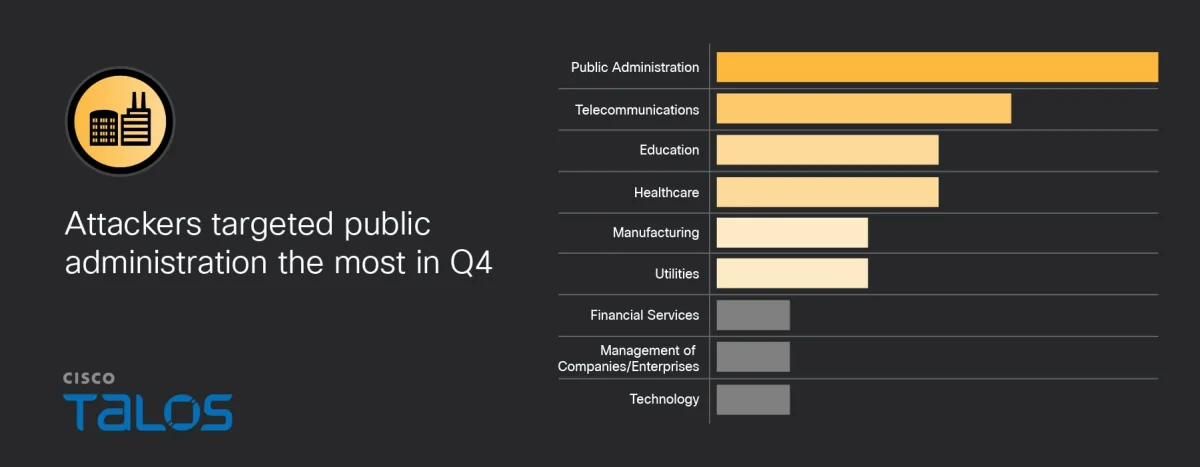
This quarter, public administration sectors emerged as particularly attractive targets, largely due to budget constraints and legacy systems that compromise security. Phishing and exploitation campaigns aimed at public administration entities demonstrate the persistent vulnerabilities within public sectors often burdened by inadequate infrastructure and resources.
The trends observed in these sectors further underscore the imperative for enhanced security measures, especially around public-facing applications and internal communication platforms. Adversaries recognizing the sensitivity of the data managed by these organizations also suggest the necessity for specialized scrutiny of existing systems and practices.
Initial Access Points
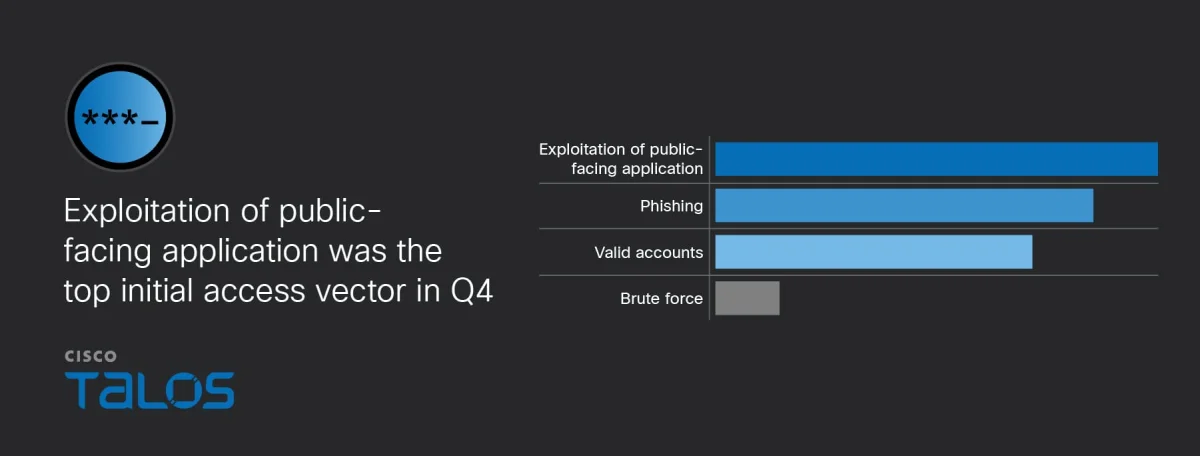
The means of gaining initial access, primarily through exploitation of public-facing applications, remains a key tactic noted within this quarter’s incident reports. This preeminence signals an ongoing necessity to enhance security for exposed IT assets. Although exploitation engagements dipped significantly, phishing tactics rose, marking a strategic pivot by cybercriminals as distinct from the previous quarter’s pattern dominated by widespread exploitation efforts.
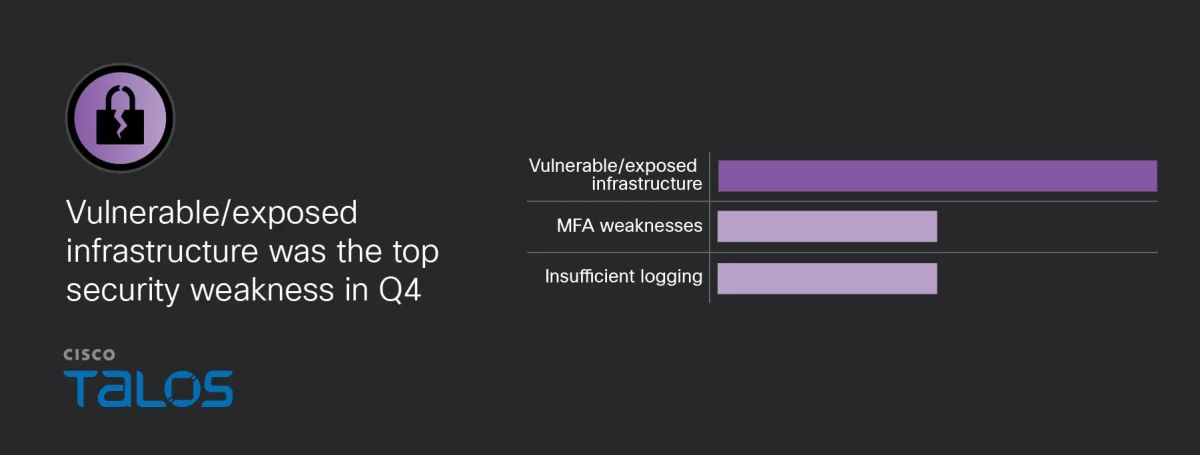
Recommendations for Enhancing Security Posture
To address the prevalent security weaknesses highlighted in Q4 2025, the following measures are recommended:
1. Robust Patch Management
A proactive patch management strategy should be implemented to address vulnerabilities as soon as they are disclosed or identified. This includes closing gaps found with publicly-facing applications and addressing known vulnerabilities in third-party services.
2. Strengthening Multi-Factor Authentication
Organizations should focus on enforcing strong MFA policies and monitoring systems more effectively for signs of MFA abuse. This includes keen oversight on new device registrations or circumventions of MFA protocols.
3. Enhancing Logging Capabilities
Centralized logging tools, such as Security Information and Event Management (SIEM) solutions, should be implemented to bolster forensic investigation capabilities. Enhanced logging ensures that any deletion or modification of logs can still be monitored through these centralized systems.
4. Promoting Timely Incident Response
Quick and coordinated incident responses have proven crucial in mitigating threats observed this quarter. Organizations are encouraged to engage with threat response teams more promptly to prevent further exploitation and potential data loss.
MITRE ATT&CK Insights
This quarter's Talos IR engagements revealed considerable insights through the MITRE ATT&CK framework, further emphasizing the resilience and adaptability of attackers:
- Adversaries utilized a wider array of credential access techniques.
- Exploitation of public-facing applications maintained its status as the primary mode for initial access.
- The continued prevalence of Remote Desktop Protocol (RDP) as a lateral movement technique further illustrates how attackers maximize accessibility in targeted networks.
In summary, Q4 2025 has exposed crucial vulnerabilities and trends that organizations must urgently address. The reiteration of exploitation tactics and the emergence of phishing campaigns as primary access points signal critical areas of focus for security teams seeking to bridge the gap against continuously evolving cyber threats.


