Examining the Security Risks of a Hardware Implant in Ledger Nano X Devices
| Shelf | AI & ML |
|---|---|
| Date in | |
| Readers | 369 |
A teardown of a counterfeit Ledger Nano X reveals significant security risks, including the mechanism of a sophisticated hardware implant.
Introduction to the Counterfeit Ledger Nano X
A fascinating case study in hardware security emerged during Joe Grand’s presentation at HARDWEAR.IO 2026 in Santa Clara. The talk, reported by oxfemale on core-jmp.org, focused on a hardware implant discovered inside a counterfeit Ledger Nano X unit purchased from a Lazada seller in Thailand. This counterfeit device, which made waves after appearing in an August 2025 Reddit post, raises essential questions about hardware integrity and the potential vulnerabilities of popular crypto wallets.
Understanding the Implant's Architecture
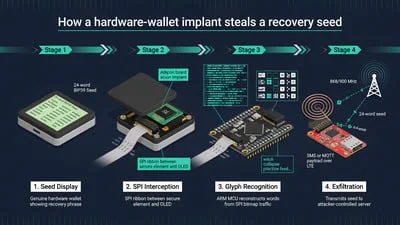
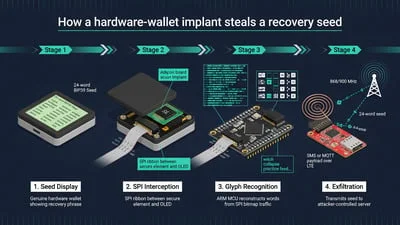
The implant itself does not interface directly with the Secure Element, which is the core component responsible for safeguarding the wallet's cryptographic keys. Instead, it is positioned adjacent to it. Notably, when the Ledger wallet displays the full 24 BIP-39 recovery words, these characters travel across the OLED's Serial Peripheral Interface (SPI) bus in an unencrypted format. This is where the implant, a minuscule 3×3 mm Cortex-M0+ microcontroller, springs into action.
This microcontroller monitors the SPI bus for traffic corresponding to the recovery words. By utilizing template matching against a pre-defined glyph table, it captures and interprets the displayed characters before consequently storing the extracted seed into its flash memory at a specific offset (0x7000). This initial readout is alarming because it exposes sensitive information that would typically remain secure within the device.
Transmission of Captured Data
Once the private seed is harvested, the implant employs a Luat Air700E LTE module equipped with a Vodafone NL data eSIM to exfiltrate the recovered data. This method of communication enables the implant to transmit sensitive information over the cellular network. The implications are profound: while a user may believe their crypto assets are secure, their recovery phrases could be intercepted and exploited without their knowledge.
Compromising the Device's Integrity
To implement the implant effectively, significant modifications were made to the original device. The impostor replaced the Ledger's battery with a smaller 70 mAh cell, providing space for the additional hardware. Disabling critical components such as the battery NTC thermistor was also necessary; instead of allowing accurate temperature readings, a fixed 10k resistor was installed. This adjustment effectively bypasses the fuel gauge, causing the device to consistently report a battery level of 100 percent, thereby obfuscating the impaired battery performance.
Investigation Techniques and Firmware Extraction
During his talk, Joe Grand elaborated on how he identified the eSIM by utilizing a PC/SC reader alongside PySim, a tool designed for sim management. Furthermore, he extracted the microcontroller firmware through the Serial Wire Debug (SWD) interface, providing insights into the deeper layers of the implant's operation.
This extraction technique is crucial as it allows researchers and security professionals to analyze how malicious actors might alter firmware to implement their attack vectors. Nonetheless, Grand pointed out that new versions of this implant have already emerged, indicating a rapidly evolving threat landscape.
Limitations and Future Watchpoints
This reverse engineering case sheds light on significant vulnerabilities in hardware wallets, particularly concerning counterfeit devices. While the Ledger Nano X has robust security measures, it's apparent that counterfeit models can compromise user security. Buyers need to ensure they purchase hardware wallets from reputable sources to mitigate the risk of tampering.
Looking ahead, heightened awareness and vigilance will be crucial as firmware analysis and microcontroller design evolve within the realm of hardware security. Watch for developments in the detection of such implants and improvements in the design of secure elements to withstand these types of vulnerabilities. Furthermore, the implications of this find underscore the importance of hardware integrity verification as a standard practice in the cryptocurrency wallet space.
As the landscape continues to shift with potentially newer and smarter attack mechanisms, security professionals and organizations must remain proactive. This incident serves as a stark reminder of the ongoing battle within cybersecurity and the need for continued education, research, and development in secure hardware solutions.
For more insights, check out the video overview of Grand's presentation and more details at core-jmp.org.


