Sipeed Launches MaixStation: A New Contender Against Nvidia DGX Spark and AMD Ryzen AI Halo
| Shelf | AI & ML |
|---|---|
| Date in | |
| Readers | 971 |
Sipeed's MaixStation, built with Axera's AX8860P chip, aims to compete with Nvidia and AMD systems at a lower price point, promising competitive performance.
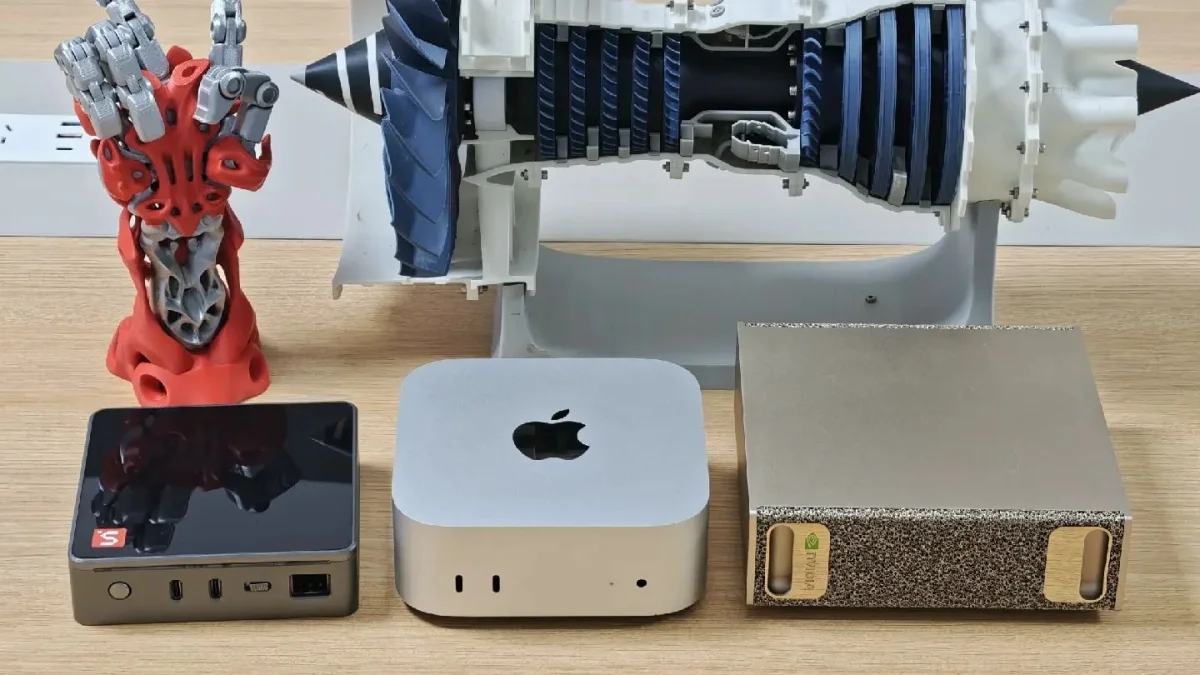
Sipeed has unveiled the MaixStation, a new system positioned as a competitor to Nvidia's DGX Spark and AMD's Ryzen AI Halo, with competitive features and pricing. Central to the MaixStation’s performance is the Axera AX8860P processor, which boasts a formidable 128GB of LPDDR5X memory on a 256-bit bus, delivering a bandwidth of 273 GB/s. Sipeed anticipates pricing the 128GB model at approximately $3,999, which places it favorably against the 128GB Ryzen AI Halo and significantly below the DGX Spark's retail price of $6,950. Interested buyers can sign up now for updates on Sipeed’s MaixStation page ahead of a Kickstarter launch later this year, with units expected to ship within three months following the campaign's conclusion.
Equipped with a 16-core Arm Cortex-A55 chip, the AX8860P integrates an in-house Neural Processing Unit (NPU) capable of reaching 256 trillion operations per second (TOPS) using native FP4 precision without sparsity. The manufacturing process for this chip is notable as it uses a modern 6nm technology. Sipeed asserts performance enhancements over the DGX Spark, claiming 25% faster prefill and 30% faster decode rates while running the Qwen 27B model. Notably, preliminary tests and benchmarks from Sipeed suggest that the MaixStation achieves around 10% better performance than the DGX Spark in both prefill and decode tasks for FP4 workflows, although these claims have not been universally verified yet.
Comparative Specifications
The following table summarizes the key specifications of the Sipeed MaixStation, Nvidia DGX Spark, and AMD Ryzen AI Halo:
Sipeed MaixStation (Axera AX8860P) |
Nvidia DGX Spark (GB10) |
AMD Ryzen AI Halo (Ryzen AI Max+ PRO 495) |
AMD Ryzen AI Halo (Ryzen AI Max+ 395) |
|
|---|---|---|---|---|
Status |
Kickstarter late 2026; specs are Sipeed’s claims |
Available; new SKU for 64GB expected Oct. 23 |
Available |
Available |
CPU |
16 Arm Cortex-A55 cores |
20 Arm cores (10 Cortex-X925, 10 Cortex-A725) |
16 Zen 5 cores |
16 Zen 5 cores |
Memory |
128GB LPDDR5X; 512GB on MaixStation Pro |
128GB LPDDR5X; 64GB available |
192GB LPDDR5X-8533 |
128GB LPDDR5X-8000 |
Memory bandwidth |
273 GB/s |
273 GB/s |
273 GB/s |
256 GB/s |
AI compute (rated peak) |
NPU: 256 TOPS FP4, no sparsity |
Blackwell GPU: up to 1 PFLOP FP4 with sparsity |
Radeon 8065S GPU (40 CUs): up to 61 TFLOPS FP16; NPU: up to 55 TOPS |
Radeon 8060S GPU (40 CUs); NPU: up to 50 TOPS |
Software |
Debian 13; NPU toolchain expected end of October |
DGX OS (Ubuntu 24.04 LTS) with CUDA |
ROCm, validated as “Best-Known Configuration” |
Linux or Windows 11 Pro |
Networking |
10G SFP+; 256 Gbps C2C link |
10GbE; requires external switch |
10GbE |
10GbE |
Price |
Expected at about $3,999 (128GB) |
$6,950 (128GB); lower for 64GB |
$7,299.99 (Linux) |
$3,999.99 |
Cost and Market Position
The MaixStation’s pricing strategy represents a significant factor in its competitive stance. Although the DGX Spark and the AMD models present strong capabilities in terms of compute and memory, they are considerably more expensive. Sipeed has opted to base its pricing on current DRAM rates rather than on stock acquired previously, which may provide better margins amid rising memory prices. Importantly, Sipeed has iterated that buyers may bring their own SSDs to further reduce their investment, as the MaixStation accommodates standard M.2 2280 drives compared to the proprietary SSD specifications often seen in competing hardware.
Software and Ecosystem
The MaixStation operates on Debian 13 and is expected to support various frameworks including vLLM, SGLang, and PyTorch. Complementarily, Axera has pledged support for ONNX and Hugging Face model formats, alongside an OpenAI-compatible API. Notably, both the DGX Spark and Ryzen AI Halo have unique software ecosystems—the former primarily reliant on Nvidia’s CUDA stack and the latter utilizing ROCm for optimized performance. The entry of the MaixStation with an open-source software approach may appeal to a segment of the market seeking flexibility over preconfigured solutions.
Future Prospects and Considerations
The emergence of the MaixStation indicates a growing trend in the market where Chinese tech companies are increasingly developing custom silicon solutions to compete with established players like Nvidia and AMD. The hardware itself supports configurations from single to quad-node setups, with a 256 Gbps C2C interconnect that promotes scalability without extra switches for additional nodes—a feature that could be attractive for users aiming to build larger configurations.
As the Kickstarter campaign approaches, interest is building around the MaixStation's final specifications and performance claims. However, potential buyers should remain cautious about the manufacturer's benchmarks, given the competitive nature of the market and the limitations that may become evident during independent testing. Awaiting further insights on the functionality of the upcoming NPU toolchain will also be pivotal for evaluating the MaixStation’s long-term viability in the local LLM (large language model) space.


