Nvidia's RTX Spark Superchip: Unpacking Its Performance in Microsoft's Surface Laptop Ultra
| Shelf | AI & ML |
|---|---|
| Date in | |
| Readers | 635 |
Nvidia's RTX Spark Superchip marks a significant leap in AI capabilities for PCs, but its gaming performance and high price raise important considerations.
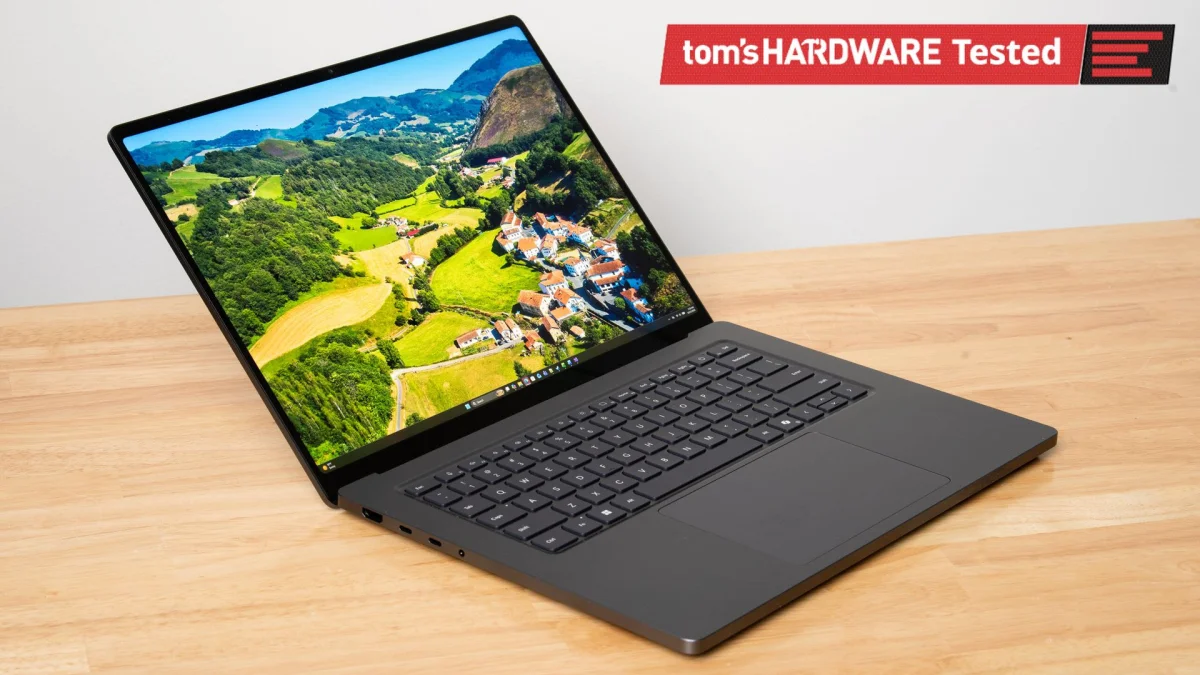
Nvidia's ambition to redefine personal computing was announced by CEO Jensen Huang during Computex 2026, where the RTX Spark platform was unveiled. At its core, the platform integrates the new GB10 Superchip with Windows on Arm, aiming to create a PC that serves as a smart, autonomous assistant for tasks ranging from work to creative endeavors. To assess this bold vision, we examined Microsoft's Surface Laptop Ultra, equipped with the full RTX Spark Superchip, featuring 20 CPU cores, 6144 CUDA cores, and 128GB of LPDDR5X-9400 RAM.
Despite the promise of new technology, certain embargoes around the launch forced us to share our insights while withholding specific system metrics like battery life and display quality. As we navigate the detailed results of this first round of testing, understanding how the RTX Spark Superchip performs across different workloads—and how it stands up against competitors like Apple's M5 Max and AMD's Ryzen AI Max+ 395—is paramount.
Local AI Performance Insights
The evaluation of local AI performance presents a complex challenge. Traditionally, metrics focused on prompt processing and token generation cycles, but as AI workflows lean toward agentic tasks, a broader measuring approach is necessary. Enter the AgentPerf-local benchmark, developed by Artificial Analysis, which captures end-to-end task completion times across numerous agent-driven AI scenarios.
For testing, we utilized two advanced models: the Qwen 3.8-27B, known for its intelligence, and the Qwen 3.6 35B A3B, which trades some intellectual performance for efficiency. Each model was run through the latest version of llama.cpp to harness available acceleration features across the systems tested.
Starting with the dense Qwen 3.8 27B, we tested its performance alongside its quantization through Unsloth's Q4_K_M. The results demonstrated impressive efficiency for the Surface Laptop Ultra, which outperformed the MacBook Pro equipped with the M5 Max SoC, finishing the benchmark 25% quicker despite the latter's memory bandwidth advantage on paper. This discrepancy hints at software maturity issues and emphasizes the greater thermal capacity available to the Surface Laptop Ultra with its 140W power adapter compared to the 96W for the MacBook Pro.
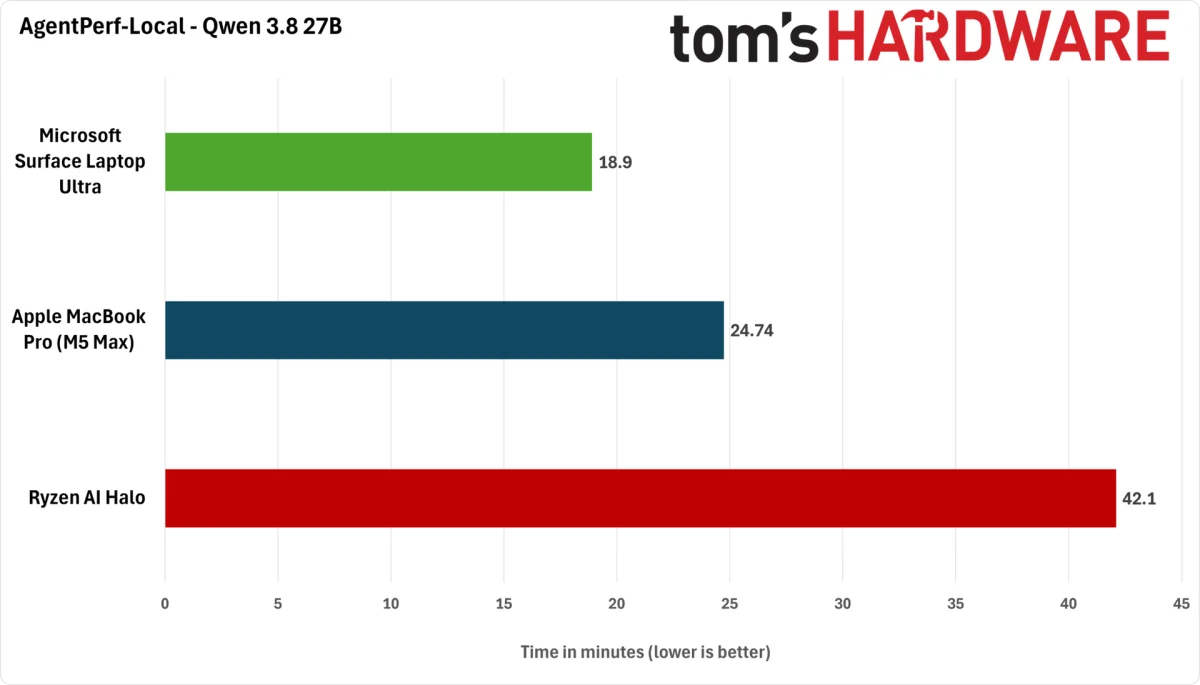
Conversely, the AMD Ryzen AI Max+ 395 lagged significantly, taking nearly twice the time to complete the same benchmark, which underscores its underwhelming performance relative to the newer architectures.
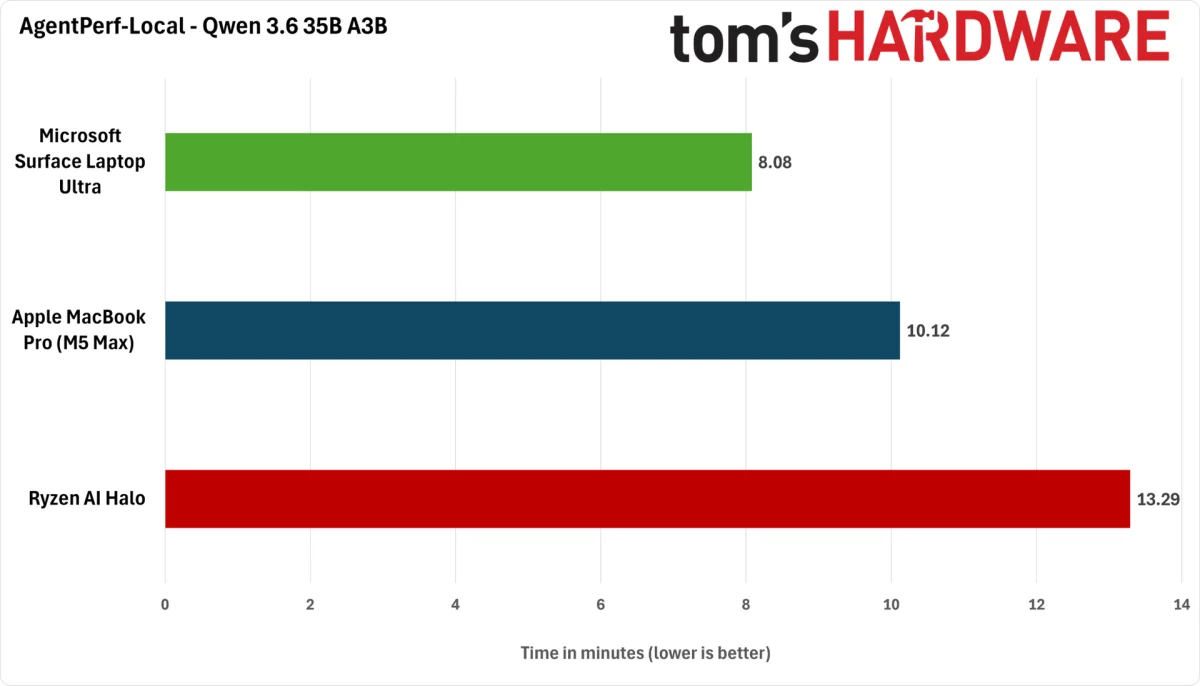
Turning to the lighter Qwen 3.6 35B A3B, results were also favorable for the Surface Laptop Ultra, completing benchmarks in just eight minutes, a notable 25% faster than the MacBook Pro and significantly more efficient than the Ryzen AI Halo, which took 13 minutes. Such comparisons are not trivial, as they illustrate the trade-offs between model intelligence and performance speed, revealing an angle of productivity that may tip the scale towards more powerful systems for demanding workloads.
Gaming Performance Challenges
Although Nvidia promotes the RTX branding and its advanced CUDA architecture, the platform faces challenges in the gaming arena. A primary concern is the lack of native game support for the Arm architecture, coupled with limited memory bandwidth of 300 GB/s shared among the CPU and GPU
. Gaming demands more from memory than other tasks typically do, and thus we anticipate the performance to be a complicated picture.My first engagement with the gaming capabilities commenced with Gears of War: E-Day, characterized by its CPU-intensive mechanics. The Surface Laptop Ultra exhibited inconsistent GPU performance, only managing around 85% utilization at a near-1080p resolution. Instances of lag during gameplay further complicated the immersive experience. Here’s a quick breakdown:
| Average FPS | 1% Low FPS | Avg PC Latency (ms) | |
| Microsoft Surface Laptop Ultra with RTX Spark | 77.7 | 39.9 | 83.5 |
It became apparent that Gears of War, with its high CPU demands, posed a significant challenge for the Prism x86 emulator, negatively affecting performance. In contrast, Control Resonant, while benefitting less from CPU power, highlighted the challenges posed by the limited bandwidth on the RTX Spark platform. High graphics settings at the native resolution hindered performance, pushing me to scale down to a windowed 2560x1440 while using DLSS upscaling effectively.
| Average FPS | 1% Low FPS | Avg PC Latency (ms) | |
| Microsoft Surface Laptop Ultra with RTX Spark | 109.2 | 51.6 | 78.3 |
Even with these adjustments, the input latency remained higher than expected compared to standard gaming rigs. In this context, while it's possible to gamely push through on the RTX Spark platform, it is not tailored for gaming as its primary function. Serious gamers looking for top-tier performance will likely find dedicated gaming laptops with RTX 50-series GPUs more aligns with their needs.
Key Takeaways and Future Considerations
As it stands, the RTX Spark platform signals an ambitious direction for PC technology, merging traditional workloads with the evolving needs of agentic AI applications. The dual-focus architecture presents a challenging competitive scenario as it endeavors to carve out a niche within an already crowded sector.
Performance evaluations across various disciplines indicate that the RTX Spark's AI capabilities outshine those of Apple's M5 Max and AMD's Ryzen AI Max+ 395 in many operational scenarios. However, the modest gaming performance serves as a significant caveat to its broader utility—unless your primary interest lies in local AI application, the gaming experience is likely to come up short for many users.
But the path to widespread adoption may face hurdles, especially given the platform's substantial price tag. The Surface Laptop Ultra, for instance, starts at an eye-watering $5899 for a relatively modest 1TB of storage, naturally fueling skepticism about its overall value versus investments in cloud AI services.
For professionals keen on keeping their work local and ensuring computational privacy, the RTX Spark still holds promise, providing sufficient performance combined with the Windows ecosystem's familiarity. Yet, this initial offering faces strong competition from cloud-based models that may deliver more power and flexibility at a fraction of the cost.
As the industry watches closely, Nvidia's task will be to ensure that software for the RTX Spark platform catches up to its hardware ambitions. Initial experiences with this cutting-edge technology are promising, but firms aiming to capitalize on AI's burgeoning capabilities will need to harness that potential through further refinements and continued investment in supporting infrastructure.
In summary, if your work demands local AI processing and you're intrigued by the potential of autonomous agents, the RTX Spark Superchip might be worth exploring. However, for those who view gaming as a priority or seek greater value for their money, it may be advisable to hold off until Nvidia and its partners refine the user experience and enhance the software landscape surrounding this innovative platform.


