Apple’s ‘Minions’ Transforms Idle Macs into a Cohesive Virtual GPU Cloud for AI Workloads
| Shelf | AI & ML |
|---|---|
| Date in | |
| Readers | 468 |
Apple's internal 'Minions' system utilizes idle Macs to optimize AI processing, cutting wait times drastically while addressing team data privacy concerns.
Apple has developed an ingenious system called “Minions,” designed to leverage idle Macs within its ecosystem to enhance the management of AI workloads. A recent paper published on arXiv by Apple researchers details this “virtual GPU cloud” concept, which significantly decreases the processing wait times for AI tasks. Once bogged down by lengthy GPU queues of over ten hours, certain tasks can now be completed in mere minutes by redistributing workloads across the network of Macs.
The Minions system operates with three main components: the “Minion Server,” “Minion Executor,” and “Minion Watchdog.” Central to its functionality is Apple Silicon, which the system exclusively uses for AI inference tasks. The Minions execute two primary types of workloads: embeddings using open-source models from Hugging Face and text generation via large language models facilitated through the Ollama platform installed on each participating Mac.
The architecture of the Minions system is built around a modular design. When a user submits a task, the Minion Server splits it into subtasks that are logged in a PostgreSQL database. Each Mac runs a Minion Executor, which pulls subtasks using REST APIs. This “pull-based execution model” eliminates the need for a central scheduler, allowing for better responsiveness as Macs operate independently to retrieve and process tasks. The results are then returned to Amazon S3 for aggregation.
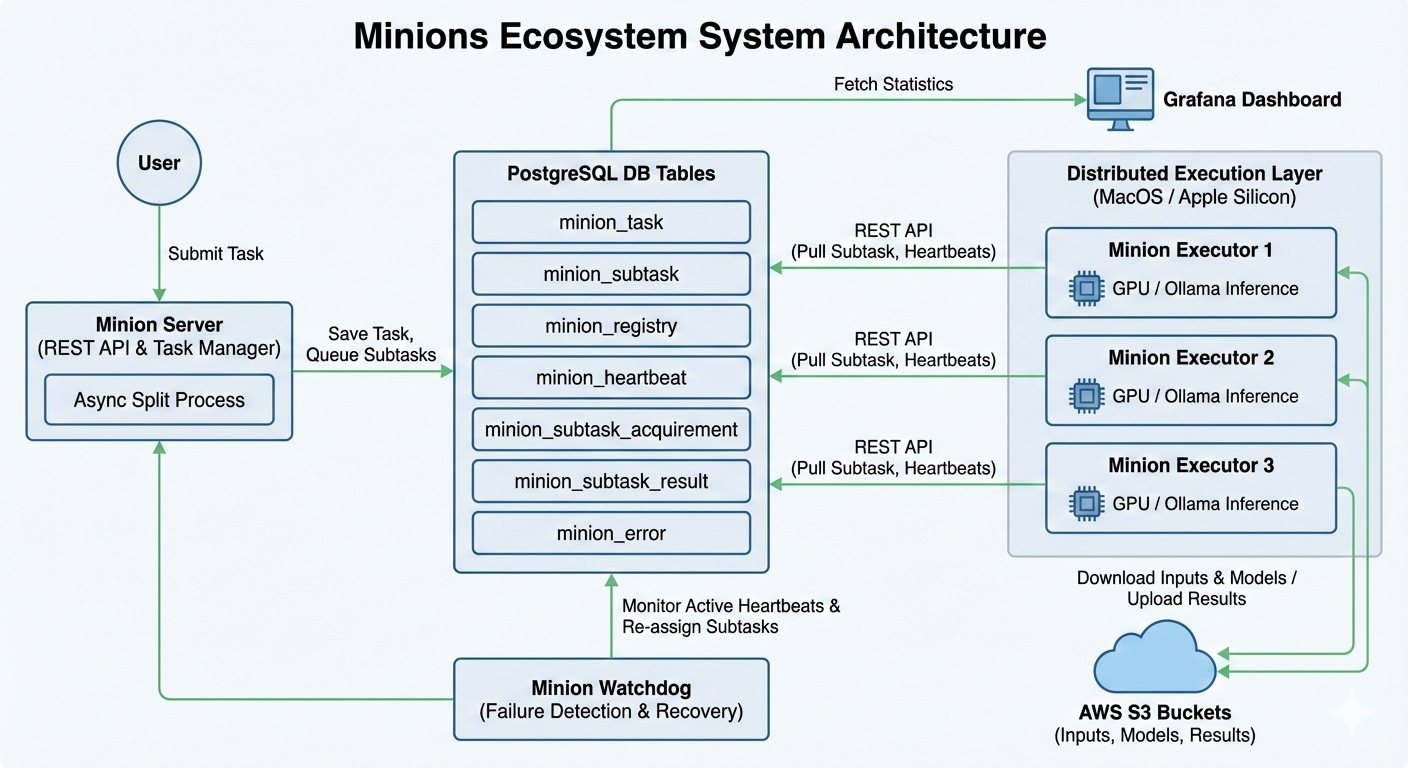
Key to maintaining operational integrity, the Minion Watchdog tracks the performance of each Mac. It monitors "heartbeat" signals sent every five minutes to verify that tasks are actively being processed. Should a Mac go to sleep, disconnect from the network, or if a user stops the executor, any unfinished subtasks are returned to the queue. Users can have a say in task allocation through “dynamic task binding,” allowing them to prioritize subtasks for specific teams or projects, though a default first-in, first-out method is also available.
Notably, each Mac runs an entire model on its own rather than splitting tasks across multiple machines. This approach aligns with practices from enthusiasts who utilize similar techniques in personal setups. The concept borrows from significant volunteer computing projects like SETI@home, which distribute workloads across a network of idle computers, thus enabling a collective computing power boost for massive AI projects.
The implications of utilizing the Minions system are profound. Not only does it dramatically reduce waiting times for GPU resources, but it also eliminates the necessity for new GPU requests, effectively lowering infrastructure costs to zero. The scalability of this initiative transitions from a manual process to a more organic one, fostering an environment where teams can efficiently harness available computing resources without additional overhead.
However, with this participation model relying on voluntary engagement, Apple has implemented strategies to mitigate confidentiality risks associated with sharing machines across projects. Each team can opt for controlled access by utilizing team-specific database deployments and separate pools of Macs to maintain organizational security.
The paper’s release comes amid growing concerns within the AI industry regarding resource constraints. Apple recently acknowledged these challenges in a quarterly filing, emphasizing the critical need for sufficient computing resources as bottlenecks become more prevalent. Their commitment to resolving capacity issues is underscored by the creation of Minions, providing a practical way to maximize existing resources in an increasingly competitive tech climate.
On the server side, Apple has introduced its Private Cloud Compute service to supplement more complex requests, which now operates on Nvidia GPUs in Google Cloud. This was initially revealed at the WWDC event, highlighting the demand for local AI processing within Apple’s ecosystem, which outstripped their manufacturing capabilities in recent months.
The authors of the Minions paper have also indicated plans for future developments, including extending this system to distributed model training—potentially aiming for a broader federated network of Macs that span different organizations or even communities worldwide. While currently limited to Apple’s infrastructure, the idea of pooling GPU resources on a larger scale presents significant opportunities for optimizing AI work and resource allocation.
In summary, Apple's Minions initiative exemplifies a pragmatic approach to tackling the challenges of scaling AI processing. By harnessing existing idle Mac resources, the system not only enhances workflow efficiency but also paves the way for future innovations in distributed computing practices.


