Meta Deploys Media Over QUIC for Enhanced Instagram Live Streaming
| Shelf | AI & ML |
|---|---|
| Date in | |
| Readers | 875 |
Meta's implementation of Media over QUIC (MoQ) for Instagram Live aims to simplify live video infrastructure and enhance streaming performance at scale.
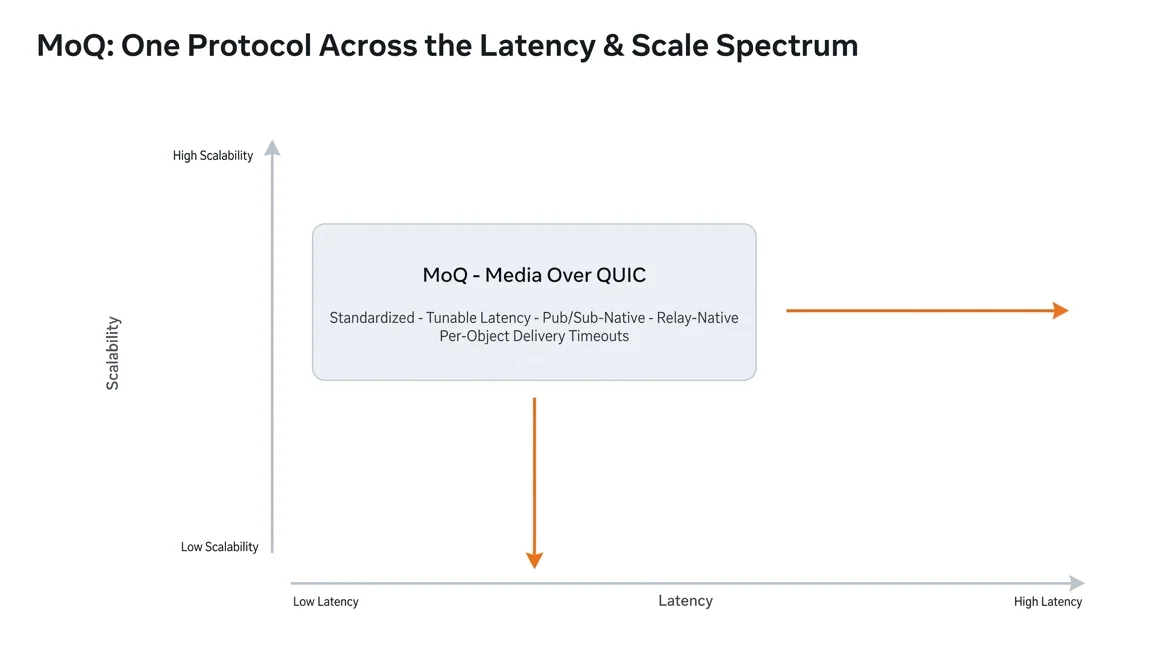
Meta has initiated deployment of Media over QUIC (MoQ), a new open protocol designed for real-time video streaming. This development primarily supports live video ingest for Instagram on both iOS and Android. By utilizing MoQ, Meta aims to streamline its protocol stack for live streaming, thereby enhancing the overall user experience for creators and viewers alike.
MoQ: Context and Evolution
In the landscape of media protocols, various standards have emerged to address specific use cases—from RTMP for ingestion to HLS and DASH for playback, with WebRTC catering to real-time communications. However, as applications evolve and features converge, the separation between these protocols becomes increasingly inefficient. Users, especially those engaging with Meta services, often encounter multiple protocol stacks for related tasks, such as streaming and voice calls. MoQ aims to consolidate this experience, providing a unified framework that reduces the need for maintaining disparate systems and operational models.
Understanding MoQ's Framework
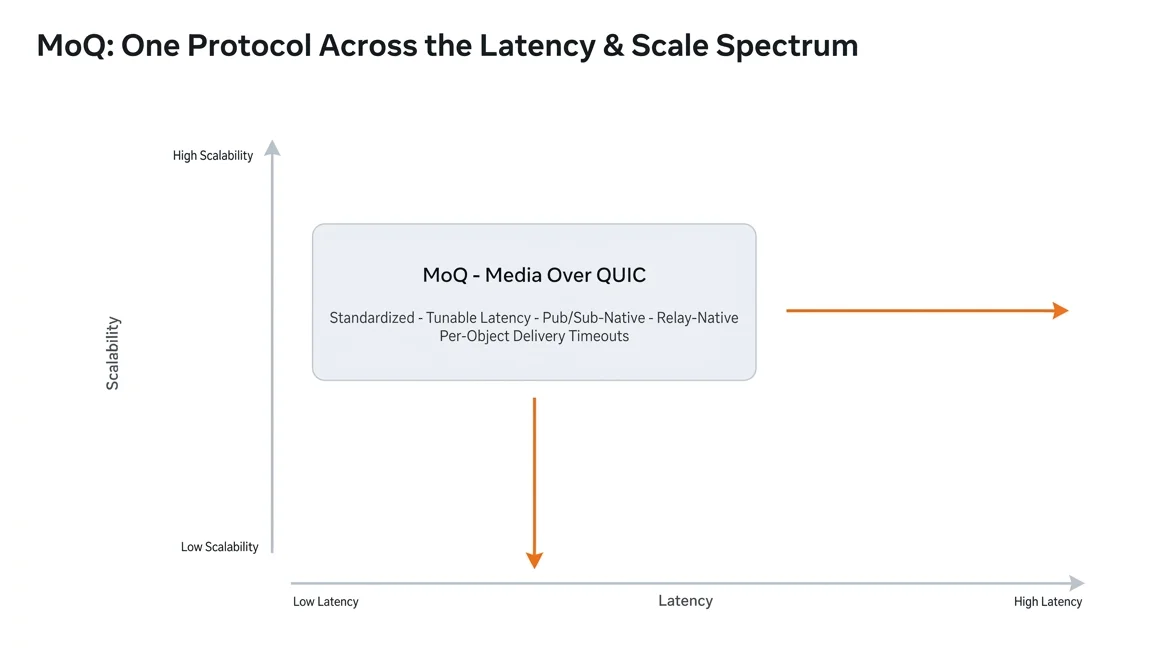
MoQ is an IETF standardized protocol designed for low-latency, scalable media delivery, built atop the QUIC transport layer. Its development is a collaborative effort between various organizations, including Meta, Google, and Akamai, among others. Prior to MoQ, Meta's live streaming was facilitated by Reliable Ultra-low-latency Streaming over HTTP (RUSH), a proprietary protocol that leveraged QUIC to overcome the limitations of RTMP. The lessons drawn from RUSH's deployment informed the decision to adopt and refine MoQ.
The essence of MoQ lies in the concept of a Track, which represents a discrete stream of media objects that are transmitted from publishers to subscribers via a network of relay nodes. Importantly, these relays can cache and forward media without the need to parse the content, focusing solely on MoQ's framing and delivery metadata.
Several attributes make MoQ suitable for supporting a diverse range of latency-sensitive applications:
- Foundation on QUIC: By avoiding TCP's head-of-line blocking, QUIC allows for independent stream progression, enabling faster connection setups and smoother migrations. This underlying architecture was previously tested through Meta’s QUIC rollout, which demonstrated significant improvements over HTTP/2.
- Built-in Caching and Scaling: MoQ's design incorporates native caching and request/stream coalescing features, ensuring media streams scale efficiently through CDN relays without additional bolt-ons—an improvement over traditional HTTP streaming.
- Tunable Latency: Subscribers can now experience different latencies from the same Track, allowing for real-time interactions or buffered experiences based on individual needs.
- Congestion Management: MoQ’s track-aware delivery enables adaptive handling of network congestion, improving performance underpacket loss conditions.
- Integrated Media Context: Quality adaptations are designed directly into the protocol’s framework, reducing the complexity of implementing adaptive bitrate strategies.
- Fallback Mechanism: MoQ can switch to standed TCP protocols in environments where QUIC is restricted, ensuring consistent performance across different network scenarios.
Implementing MoQ for Instagram Live
Meta chose to deploy MoQ on Instagram Live primarily due to its extensive user base, which represents one of the most challenging scenarios for live video ingests. The decision was influenced by three key factors:
- Scale Testing: Instagram Live serves users at a massive scale, making it an ideal platform to test MoQ’s capabilities for high-demand ingest workloads.
- Transition from RUSH: The switch from RUSH to MoQ not only fosters a move toward an open ecosystem but allows other contributors to enhance the protocols collaboratively rather than relying solely on Meta’s development.
- Setting Baseline Metrics: Demonstrating MoQ's capability to match RUSH’s performance is crucial for future developments, providing a reliable foundation for extending the application to other functions such as live playback.
Challenges in the Deployment Process
Transitioning from one transport protocol to another within a live production environment presents various challenges that extend beyond the protocol’s technical specifications:
- Integration Across Multiple Apps: Meta leveraged moxygen, an open-source MoQ library, to facilitate integration across its app ecosystem. This cautious approach ensured compatibility with existing systems.
- Edge Translation Implementation: To minimize backend disruptions, a translation layer at the edge was established to convert MoQ frames into the RUSH format, allowing for a smooth rollout without impacting downstream systems.
- Streamline Routing for Experimentation: By routing broadcast URLs based on user group membership, Meta is able to efficiently manage rollout phases without dependency on individual app updates.
Observations from the Deployment
After thorough testing, MoQ was successfully launched for Instagram Live ingest. This implementation matched the performance metrics previously achieved through RUSH, confirming that the transition was executed without noticeable disruptions for users.
Achieving this parity has positioned Meta to further optimize live video delivery in future developments. The next phases will focus on building an end-to-end architecture utilizing MoQ, enabling real-time media pushing and improvements in reliability and quality as bandwidth varies.
Future Prospects for MoQ within Meta
With MoQ now operational for Instagram Live, Meta is exploring additional applications for this unified transport system. Potential areas for further development include:
- Extending Live Ingest Capabilities: Future work will expand MoQ's reach across additional Meta apps, integrating sophisticated constructs for managing audio, video, and associated metadata more effectively.
- Enhancing Real-time Interactions: As real-time AI applications evolve, MoQ's low-latency features will be pivotal in supporting continuous two-way communications, aligning with the increasing demand for responsive interactions.
Meta’s implementation of MoQ signifies a substantial advancement in media transport protocols, setting a foundation for significant improvements in the streaming experience across multiple platforms.
Learn More About MoQ
To explore more about MoQ and its ongoing development, visit the MoQ Transport IETF draft and check out the moxygen open-source library.


