Introducing MetaRoCE: Redefining RDMA Transport for AI-Driven Ethernet Networks
| Shelf | AI & ML |
|---|---|
| Date in | |
| Readers | 387 |
MetaRoCE is a new RDMA transport protocol from Meta, engineered for high-performance AI workloads over Ethernet, enabling greater efficiency and scalability.
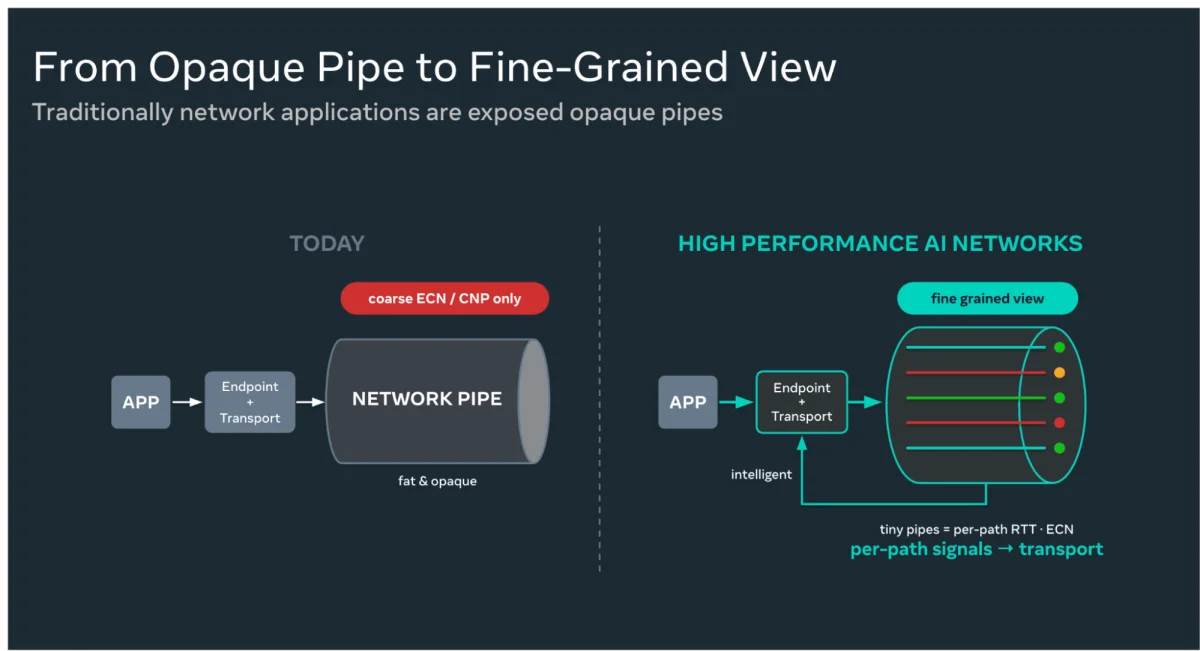
As the demand for training and serving advanced AI models skyrockets, the backbone of this infrastructure increasingly relies on fast and reliable networking. Meta's latest initiative, MetaRoCE, seeks to meet this demand by providing a purpose-built RDMA transport protocol optimized for AI workloads on standard Ethernet, enhancing performance and efficiency without requiring specialized hardware.
MetaRoCE represents a significant leap from existing technologies. Unlike standard RDMA over Converged Ethernet (RoCE), which expects in-order packet delivery, MetaRoCE is built from the ground up to facilitate high throughput and low latency in massive GPU deployments, facilitating distributed AI training across clusters that span multiple data centers and regions. This initiative will be released via the Open Compute Project (OCP) and includes a specification, a reference software implementation, and a compliance test suite to ensure wider industry adoption.
Meta's approach stems from their track record supporting distributed AI training, demonstrating the capabilities of RoCE in large-scale environments. Now, with MetaRoCE, the aim is to provide a transport protocol capable of supporting communication across millions of GPUs without the bottlenecks presented by traditional networking protocols. Slowdowns during collective operations like all-reduce or communication between model shards can severely limit performance, making the efficiency of the communication fabric paramount.
Understanding MetaRoCE
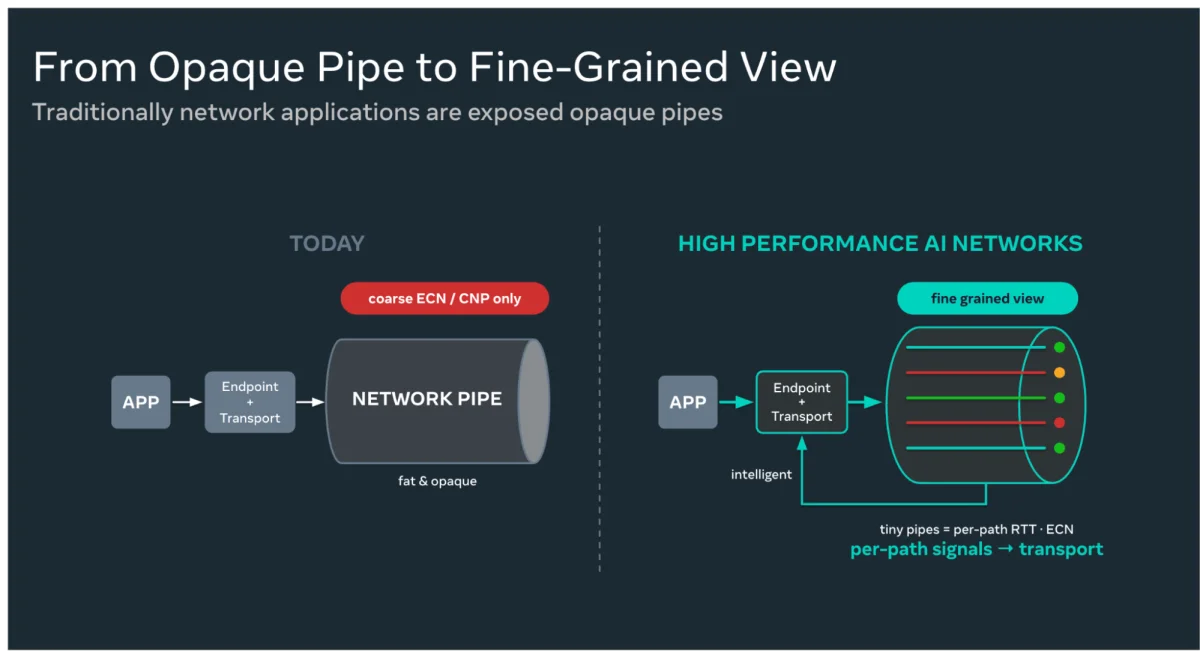
The fundamental principle behind MetaRoCE is the redistribution of intelligence from the network fabric to the endpoints. By doing so, MetaRoCE enables per-path telemetry that records metrics like round-trip time (RTT), Explicit Congestion Notification (ECN) state, and utilization for each logical path within the network. This architecture allows MetaRoCE to operate more efficiently than traditional methods, treating out-of-order packet arrival as standard operating procedure.
Key Features of MetaRoCE
1. Native Out-of-Order Delivery
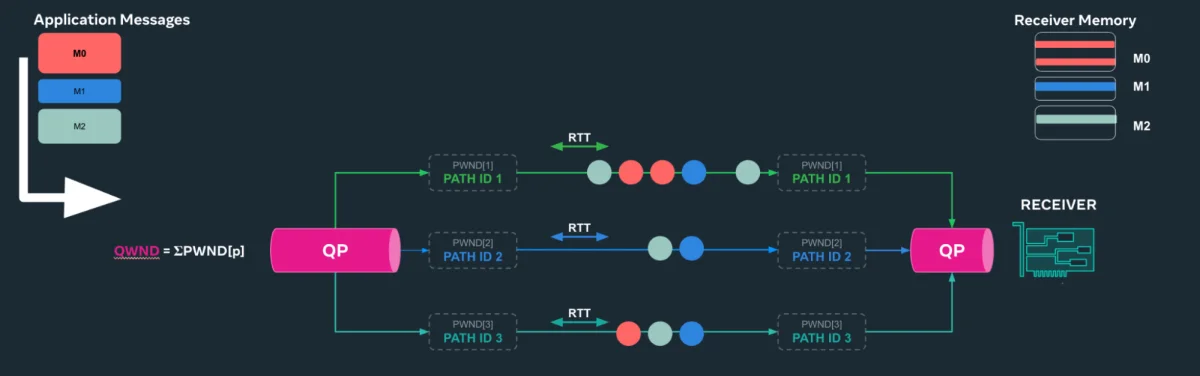
MetaRoCE intentionally distributes packets across multiple paths, allowing for out-of-order arrival. This means that as packets reach their destination, they can be written directly into memory without requiring a reorder buffer, eliminating head-of-line blocking. Hence, data can be efficiently placed in memory immediately on arrival, streamlining operations and speeding up processing times.
2. Native Multipathing
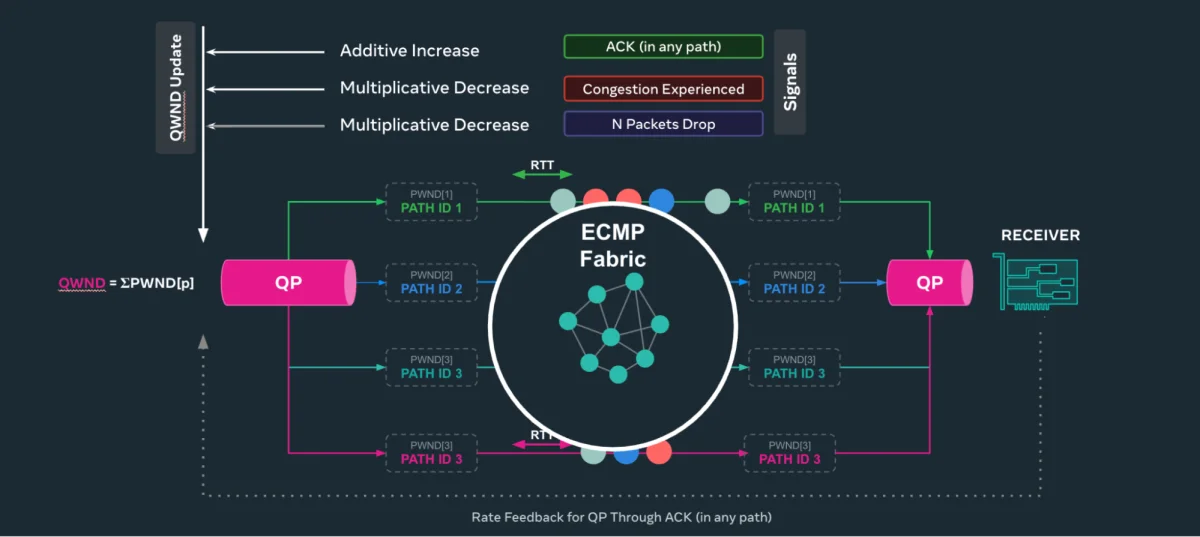
The protocol supports multipathing inherently, meaning it can concurrently utilize various paths for data transfer. Each path is characterized with its unique UDP source port, facilitating load distribution and the ability to reroute traffic dynamically in response to network conditions. This feature allows for real-time management of congestion and failure scenarios without interrupting overall communication.
3. Loss Tolerance by Design
MetaRoCE embraces the potential for packet loss, rejecting the assumption that the underlying Ethernet fabric must be lossless. This design choice negates the need for pause frames or enhanced flow controls, leading to a more stable operation even under adverse conditions. Loss detection is handled through selective acknowledgments, allowing for precise retransmission of only the lost packets, thus maintaining data integrity and performance.
4. Congestion Control from Both Ends
The protocol marries sender-driven additive increase/multiplicative decrease (AIMD) congestion control with receiver-driven bandwidth hinting. This dual approach ensures efficient bandwidth allocation and responsiveness to network congestion while maintaining equitable throughput among all senders within a connection.
5. Topological Independence
MetaRoCE is built with flexibility in mind, operating with a wide variety of fabric topologies including fat-tree, multiplane, and both vendor-supported and proprietary environments. The protocol requires only basic features from the switches, enabling it to adapt across various deployments without necessitating specialized configurations.
6. Unified Connections at Scale
MetaRoCE maintains a singular connection carrying multiple message streams and paths. This model contrasts with traditional RDMA's requirement for multiple queue pairs (QPs), simplifying the connection management as the parallelism of workloads increases.
Real-World Applications
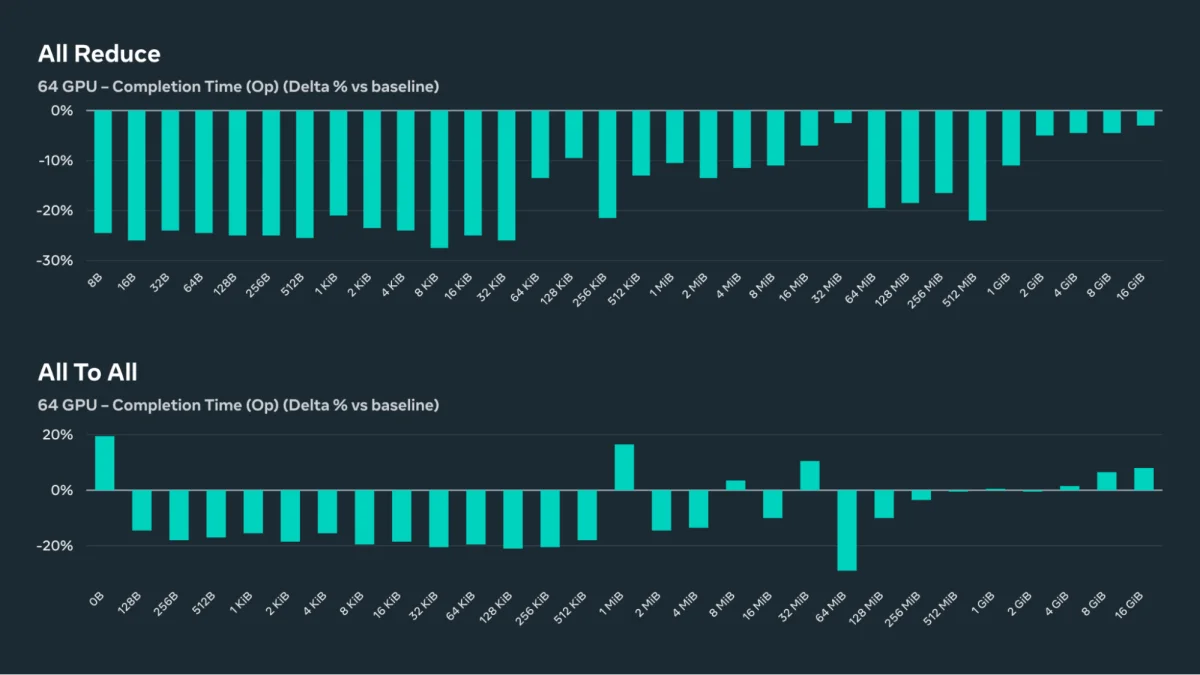
In collaboration with AMD, Meta has validated MetaRoCE on their Pensando programmable network interface cards (NICs). Testing involved a 64-node GPU cluster executing RCCL collectives, with results highlighting significant advantages over RoCEv2. MetaRoCE demonstrated higher throughput and maintained operational integrity even under packet loss conditions—performing effectively at a 1% loss scenario and considerably well at up to 10% loss.
Moreover, evaluations under multiplane configurations indicated that performance scales predictably with the number of planes involved. This predictability is enhanced by MetaRoCE's ability to reroute traffic and recover autonomously from link failures, ensuring that applications remain operational with minimal interruptions.
Commitment to Openness
MetaRoCE embodies an open-source philosophy aiming to accelerate innovation in AI infrastructure. By contributing the specification to the Open Compute Project, Meta is inviting hardware vendors to implement this protocol. This contribution includes a software reference library compatible with standard Linux environments, highlighting Meta's commitment to interoperable technology.
Looking Forward
While MetaRoCE marks significant advancements in data center networking, the journey is ongoing. Areas of further innovation involve optimizing performance across short-distance and long-distance communications, improving latency in dense rack environments, and effectively managing data transfers over long-haul links. Future developments will aim to adjust the protocol to better accommodate the evolving demands of storage and distributed cache uses, including balancing rates during incast situations.
With the upcoming release of the MetaRoCE specifications, including a DPDK-optimized software version and compliance tools, the avenue for industry collaboration and evolution opens. If you're involved in networking hardware, switches, or AI infrastructure, Meta's efforts present an opportunity to shape the future of Ethernet-driven AI deployment.
The future of networking for AI is being built in the open, and your involvement can help drive innovation further.


