Meta's MTIA 300 Chip: Revolutionizing Training Efficiency with Integrated NICs
| Shelf | AI & ML |
|---|---|
| Date in | |
| Readers | 513 |
Meta's MTIA 300 brings integrated networking and advanced communication offloading, enhancing the efficiency of training recommendation models over traditional GPUs.
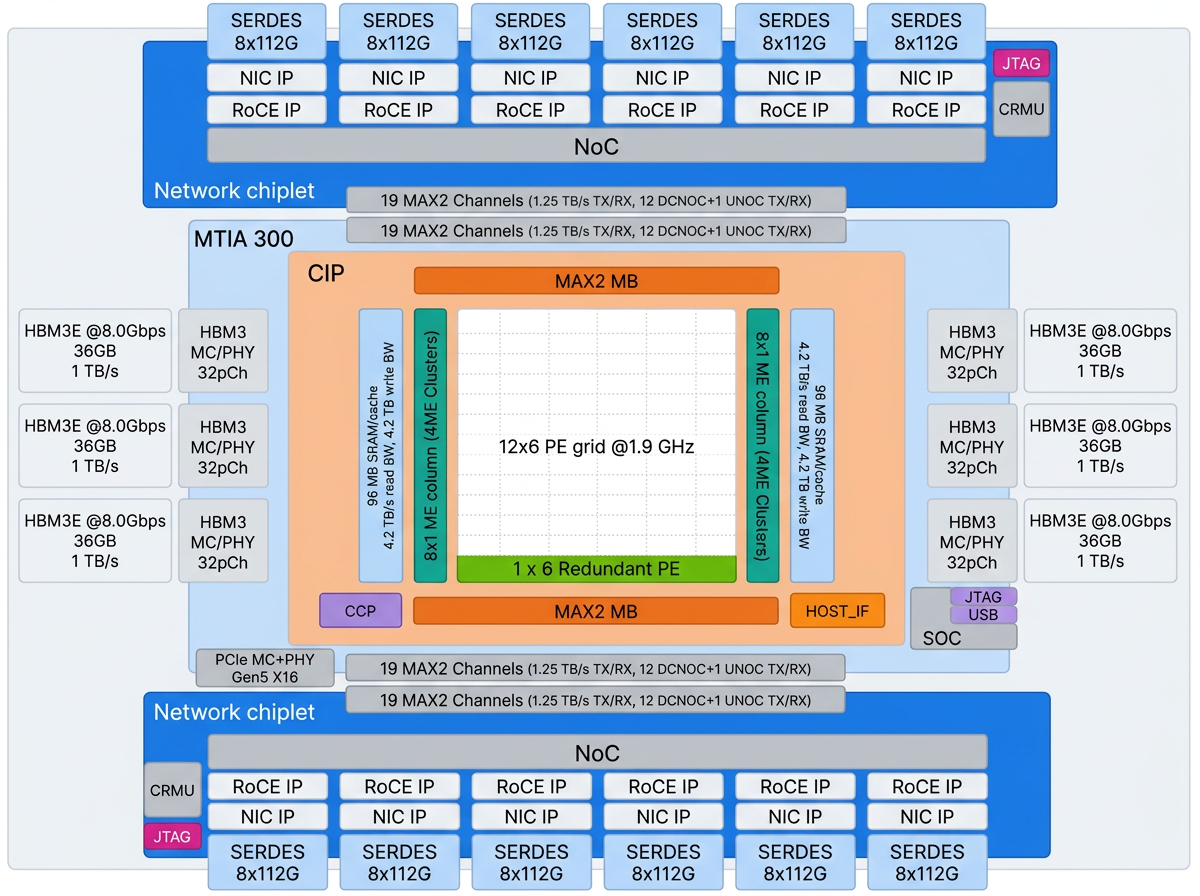
Meta has unveiled the MTIA 300, a pioneering addition to its in-house family of AI chips tailored for training recommendation and ranking models. This innovation comes at a crucial time as recommendation systems have become increasingly complex, demanding more sophisticated computing power and seamless communication between training accelerators.
Addressing Unique Infrastructure Challenges
Recommendation models present distinct infrastructure hurdles that differentiate them from large language models. While the latter require high floating-point performance, recommendation models are primarily restricted by the need for swift and efficient communication among multiple accelerators during the training process. These models often utilize embedding tables that may encompass over 99% of their parameters, requiring methods such as hybrid parallelism for effective training.
This hybrid approach prompts frequent AllReduce, AllToAll, and AllGather collective communication operations across extensive arrays of accelerators. Traditional chips, like GPUs, struggle with these operations because they can compete for resources needed for computation. As a result, this leads to suboptimal hardware utilization, straining the model training process.
Innovative Chip Design: MTIA 300
The MTIA 300 addresses these issues through a fundamentally different chip architecture. By implementing communication as a priority in its design, the chip minimizes the burden on general-purpose compute cores. This approach is evidenced by the co-design of the chip with the HCCL (High-performance Collective Communication Library), making communication a first-class entity in the architecture.
Direct Integration of Network Interface
One of the standout features of MTIA 300 is its integrated network interface. The architecture includes two network chiplets with six custom 800 Gbps RDMA (Remote Direct Memory Access) NICs per chiplet, delivering an impressive 1.2 TB/s I/O bandwidth. Remarkably, this is accomplished without using PCIe buses, thereby eliminating latency bottlenecks common in traditional GPU designs where CPUs act as intermediaries.
This chip enhances flexibility, offering a dual capacity for scale-up communication within a single rack (up to 1 TB/s) as well as scale-out communication across racks at 200 GB/s. This capacity for reconfiguration allows the network to adapt to variable model requirements dynamically.
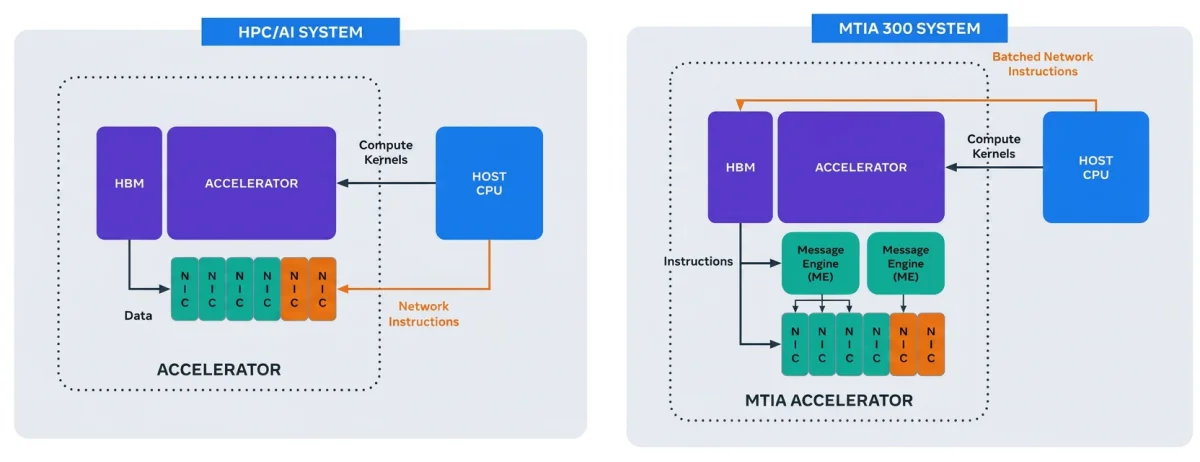
Communication Offloading for Efficiency
MTIA 300 adopts a notable divergence from GPU design by employing dedicated messaging engines (MEs) for handling communication tasks. The chip is equipped with a grid of 12x6 processing elements (PEs) for computational tasks, along with 16 MEs that independently manage all communication. This offloading of communication duties significantly alleviates the competition for computational resources that typically affects GPU workload management.
Each messaging engine includes a RISC-V core that orchestrates communication, an interface directing logics to specific NICs, and a near-memory compute (NMC) block that performs reductions at 128 bytes per cycle. Positioned at the edges of the chip near HBM (High Bandwidth Memory) and caches, the NMCs deliver an aggregate reduction throughput exceeding 2.8 TB/s. This design enables collective operations to maintain execution without interrupting the compute grid, preserving throughput efficiency.
Developing a Compiled-Communication Model
The HCCL library, specifically co-designed with the MTIA 300 chip, replaces traditional host-driven communication with a compiled-communication approach. This means that the communication tasks are pre-compiled into a series of subgraphs that can operate autonomously once instructed, thereby minimizing CPU involvement post-instruction delivery.
The compiled model integrates smoothly with PyTorch's c10d and torchcomms interfaces, optimizing collective operations throughout model training. HCCL strategically selects algorithms that make optimal use of the established bandwidth capabilities, especially given the varied scale-up and scale-out bandwidths, which is particularly crucial for inference workloads.
Performance Metrics
The results from using MTIA 300 are compelling. The HCCL library achieves a staggering 940 GB/s of communication bandwidth within a single rack. In a practical application, demonstrated with a 150 billion-parameter production recommendation model across 40 accelerators, MTIA 300 performed 3.9 times faster in communication speeds compared to conventional GPU configurations. This efficiency underpins the chip’s advantage in reducing overall training latencies and communication overhead.
Future Applications and Broader Implications
While the MTIA 300 was primarily crafted for recommendation model training, its architectural underpinnings are poised for adaptation across a range of workloads. As AI models evolve toward more complex tasks requiring reasoning and nuanced interactions, the architecture’s strengths—integrated networking, collective execution offloading, and co-designed computational and communicative processes—will better serve the demanding criteria of future AI applications.
Emerging AI workloads are likely to exhibit smaller, more frequent messages that will necessitate low-latency communication. The evolutionary patterns established with MTIA 300 and HCCL are fundamental to Meta's plans for its next-generation AI silicon.
Learn More About MTIA 300
For further insights into the MTIA 300's design and collective communication strategies, refer to the following papers:
- MTIA 300: Meta’s First Training Chip Featuring Built-in NICs and Collective Offloading Engines (From ISCA ‘26)
- HCCL: Collective Communication for Meta Training and Inference Accelerators (to be published at SC26)
For more details, visit the original post on Engineering at Meta.


